The explanations for all ten questions sit on this sheet. Pick an answer on the left and the matching card lights up.
-
T4A01 Explanation 1
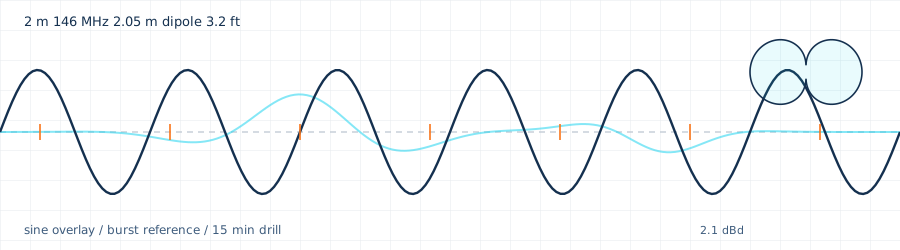
Key C — 3.2 feet
468 / 146 = 3.2 feet, or about 98 cm. The 2.05 foot figure is the wavelength in metres misread as feet, and 6.4 feet would resonate near 73 MHz.
Rule Fundamentals - antenna length formula
-
T4A02 Explanation 2
Key B — It compensates for end effect and converts the result to feet
The physical half wavelength in feet is close to 492/f. Practical antennas resonate slightly short of that because of end effect, and the shortened constant builds in the correction.
Rule Fundamentals - antenna practice
-
T4A03 Explanation 3
Key A — About 73 ohms
A resonant centre-fed dipole presents about 73 ohms, which is close enough to 50 ohm coax that the mismatch costs little. Folded dipoles and some verticals land near 300 ohms or lower, depending on height above ground.
Rule Fundamentals - antenna impedance
-
T4A04 Explanation 4
Key D — RG-213, because its larger diameter has less dielectric and conductor loss
Loss falls as the cable gets physically larger. RG-58's thin centre conductor and small dielectric diameter make it the lossiest of the three at VHF, which is why short jumpers use it and long runs do not.
Rule Fundamentals - transmission line loss
-
T4A05 Explanation 5
Key C — The antenna system is matched and no power is reflected
SWR measures mismatch only. A 1:1 reading says nothing about feed line loss, radiated power or grounding - a dummy load gives a perfect 1:1 while radiating almost nothing.
Rule Fundamentals - standing wave ratio
-
T4A06 Explanation 6
Key B — About 11 per cent
Reflected power is the square of the reflection coefficient, and for 2:1 that coefficient is 1/3, giving about 11 per cent. The 4 per cent figure belongs to 1.5:1 and 25 per cent to 3:1.
Rule Fundamentals - reflection coefficient
-
T4A07 Explanation 7
Key A — Many transmitters fold back output to protect the final stage, and reflected power is lost in the feed line
Two mechanisms work together: protective power fold-back in the transmitter, and the double loss suffered by reflected power travelling back and forth along a lossy line.
Rule 47 CFR §97.307 - spurious emission and transmitter performance
-
T4A08 Explanation 8
Key D — About 0.66 of it, because of the cable's velocity factor
Signals travel more slowly in the dielectric, so physical lengths inside coax are shorter by the velocity factor - about 0.66 for solid polyethylene and about 0.8 for foam dielectric.
Rule Fundamentals - velocity factor
-
T4A09 Explanation 9
Key C — To couple a balanced antenna to unbalanced coaxial feed line
A dipole is a balanced load and coax is an unbalanced line; without a balun, current flows on the outside of the coax shield, causing pattern distortion and RF in the shack. A balun can also transform impedance, but its defining job is the balanced-to-unbalanced transition.
Rule 47 CFR §97.13(c) - RF exposure and station practice
-
T4A10 Explanation 10
Key C — About 1.6 feet (49 cm)
234 / 146 = 1.6 feet, about 49 cm - half the dipole figure, as expected. The vertical needs a ground plane or radials to take the place of the missing half of the dipole.
Rule Fundamentals - quarter-wave vertical